How to monitor a domain without losing the context
A practical guide to domain monitoring: choose the changes that matter, keep a reliable baseline and verify alerts before you act.

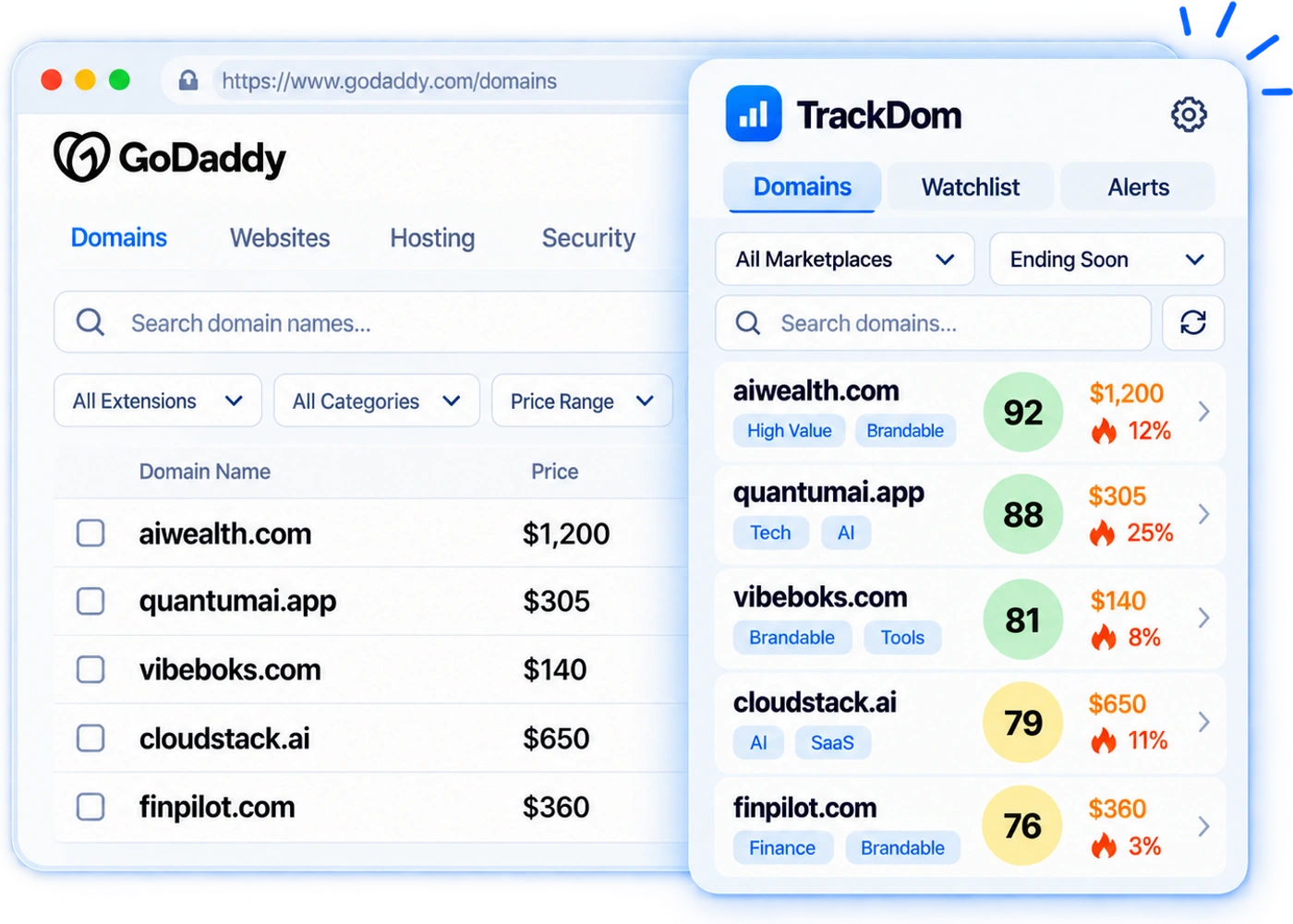
Illustrative product interface. Names, scores and prices are examples.
Domain monitoring is the repeated observation of a domain or its marketplace listing for relevant changes. Start with the exact domain, save a dated baseline, choose the events you want to review and verify important changes at their original source. Monitoring helps you notice movement; it does not reserve a domain or guarantee availability.
Start with a question, not a notification
A domain can matter for several different reasons. You may want a name for a future product, follow an auction you have already researched, or compare asking prices across a shortlist. Each purpose calls for different information. A broad request to track everything usually produces a long list of observations with no clear next step.
Write down the decision you are trying to make before you choose a tool. For a potential acquisition, the question might be whether a listing becomes affordable. For an auction, it might be whether the deadline or bid has changed. For a domain you already own, the question may concern renewal or operational health, which requires registrar or website monitoring rather than an aftermarket watchlist.
Keep the scope narrow enough that you can describe what you would do when something changes. If you cannot explain why an event matters, it probably belongs in a periodic review rather than an urgent alert. This distinction also makes it easier to compare monitoring products by their actual coverage instead of the number of notifications they advertise.
What should a domain monitoring baseline contain?
A baseline is your first dated record of the information you are following. Save the exact domain and extension, the marketplace URL, the listing type, the displayed currency and the time you checked it. Add the current asking price or bid only when it is clearly identified. A screenshot can support a note, but a source link is essential for checking the latest state.
Treat each marketplace listing as a separate observation. Two pages may show the same domain with different currencies, sale methods or update times. A buy-now price is not directly interchangeable with a current auction bid. Record the difference rather than choosing the smaller number and assuming it represents the full acquisition cost.
Registration data is another source of context. ICANN Lookup provides a place to inspect public registration information, but redacted data and status codes need careful interpretation. A lookup result is not proof that a marketplace seller controls a name, and a date alone is not a promise that a domain will become available.
- Exact domain, including the top-level domain.
- Original listing URL and marketplace.
- Observed price or bid, currency and listing type.
- Observation time and the displayed auction deadline, if present.
- Your reason for following the domain and the next fact to verify.
Source: Check public registration information with ICANN Lookup.
Which domain changes are worth monitoring?
Choose signals according to your decision. Price movement can prompt a fresh cost review. An approaching auction deadline can prompt a source check. A listing that disappears may require investigation, but disappearance alone does not tell you whether the domain sold, was withdrawn or is temporarily unavailable.
It helps to separate a fact from your interpretation. “The displayed price changed” is an observation. “The seller is motivated” is an interpretation. Keep both in your research notes if useful, but do not let an automated event silently become a conclusion about the seller, demand or the likelihood of completing a purchase.
| Observed change | A useful next check | What it does not establish |
|---|---|---|
| Price moved | Confirm currency, fees and listing type. | A bargain or a completed sale. |
| Deadline is near | Open the auction and check its current rules. | A guaranteed closing time. |
| Listing disappeared | Check the original page and account status. | That somebody bought the domain. |
| Registration status changed | Read the status definition and registrar context. | Immediate public availability. |
How often should you check a tracked domain?
There is no single interval that fits every research task. An early-stage naming shortlist can be reviewed periodically. An active auction deserves closer attention through the auction platform itself. Use the tool’s stated refresh behavior and last successful observation time to decide how much confidence to place in an alert.
An alert can be delayed by the data source, scheduled checks, network conditions or notification permissions. The absence of an alert is not evidence that nothing happened. Keep a direct reminder for a time-sensitive decision and check the source before making a commitment. A research monitor complements that habit; it should not become your only clock.
Where a tool shows a last-checked time, read it as part of the information. Where it does not, ask about freshness before relying on it for deadlines. A detailed old observation can be less useful than a simple current one. If data conflicts, preserve both observations with their timestamps until you can resolve the difference.
Does an expired domain become available immediately?
No. An expiration date is not an immediate release date. Renewal and recovery processes can apply, and the relevant registry, registrar and domain extension affect what happens next. ICANN explains renewal and expiration for generic top-level domains; country-code domains can follow different policies.
For research, keep the registration expiration date separate from a marketplace auction deadline. They describe different processes. Do not turn either into a promised acquisition date. If you own the domain, check your registrar account and renewal terms directly rather than depending on a third-party alert to preserve your registration.
Build a small monitoring routine you can maintain
At each review, open the original listing, update the baseline and write down whether your next action changed. If the domain no longer fits your purpose, remove it from active monitoring. Keeping an interesting name in an archive is different from giving it an ongoing claim on your attention.
TrackDom brings domain research and watchlists into an extension workflow, with monitoring where supported. Check the current product and plan details for available sources and allowances. The useful habit is the same with any tool: connect each alert to a specific question, verify the source and preserve enough context that you can explain your decision later.
Finish a review with one of three outcomes: continue watching, investigate a named uncertainty or stop following the domain. This creates a record of your thinking instead of a growing collection of saved tabs. Over time, that record is more useful than the raw number of alerts you received.
YOUR NEXT STEP
A useful monitor connects a dated observation to a decision. Keep the source, the context and the next check together.
Keep your source links and the next question beside the domain you are researching. For available TrackDom features and plan limits, review the current product details.
Published by TrackDom ·
Educational research guidance. Examples do not represent current listings, offers or guaranteed outcomes. Check linked sources for current procedures.
Suggest a correction